
The role of commercial fencing on business properties like retail plazas, industrial parks, office campuses and public commercial areas is very vital as they provide a safe and reliable way to protect business premises and people. In addition, they also help enhance the visual quality of the site and help promote the business image. When selecting a fencing system, values like security, durability and affordability should be maintained.
Over the years, steel and wrought iron commercial fencing has become very popular and is still used on most projects. Modern commercial fencing projects require better long term value and easy maintenance and as a result, aluminum fencing is becoming a very viable option to most developers and contractors. This is as a result of the high strength, safe design and low maintenance requirements over the life of the fence
This article focuses on evaluation of aluminum, steel and wrought iron fencing in the areas of durability, maintenance requirements, costs, customization and ease of installation. The purpose is to help project owners, designers and contractors to the reasons why aluminum fencing is the best option for a majority of commercial projects.
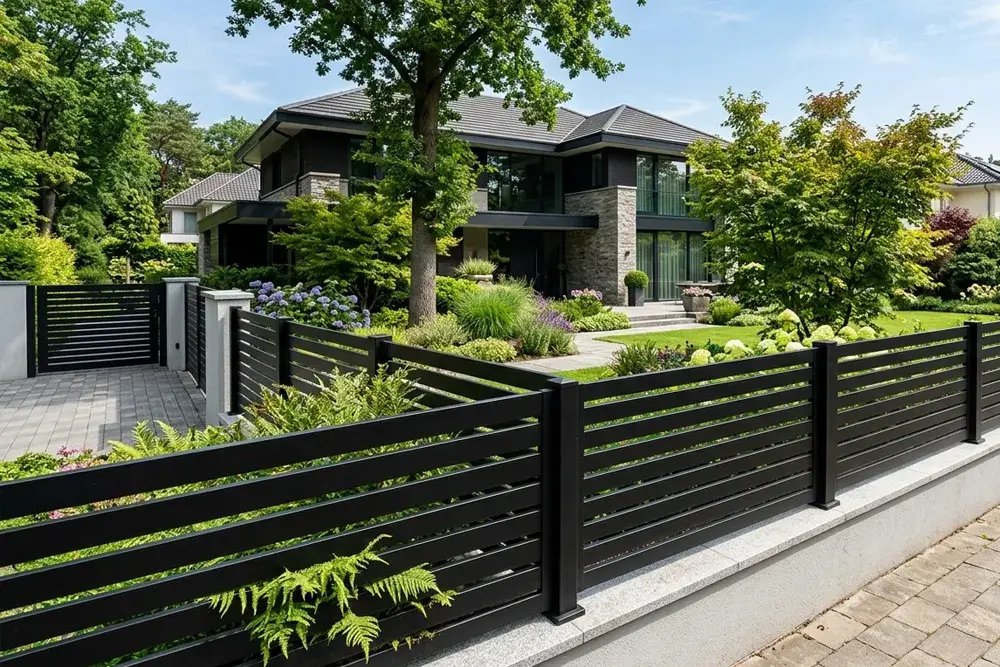
Key Considerations for Commercial Fencing
Non-negotiable core requirements for commercial projects
Commercial fencing must meet several basic needs. Security is the first concern. The fence should protect property, equipment, and people inside the site. Strong structure is necessary for daily use in retail plazas, office campuses, and industrial parks.
Low maintenance is also important. Businesses prefer fencing that needs simple care. This helps reduce repair work and long-term operating cost. Appearance also matters. The fence should match the building style and support the brand image of the property.
Durability is another key point. Commercial fencing stays outdoors for many years. It must resist rain, rust, sunlight, and temperature changes. Cost must also stay reasonable. Project owners usually compare the initial price and the long-term value.
Customizability is useful for many projects. Commercial spaces often have different layouts, sizes, and design themes. A fence that can adjust to these needs becomes more practical.
Why material choice is make-or-break for commercial fencing success
Material choice affects the performance of the fence. Poor materials may cause rust, damage, or frequent repairs. This increases maintenance work and replacement cost. It can also reduce security and visual quality.
A suitable material supports long-term stability. It keeps the fence strong, easy to maintain, and visually clean. Good material selection also improves the overall value of the commercial property.
Aluminum vs. Steel vs. Wrought Iron Fencing: Head-to-Head Comparison
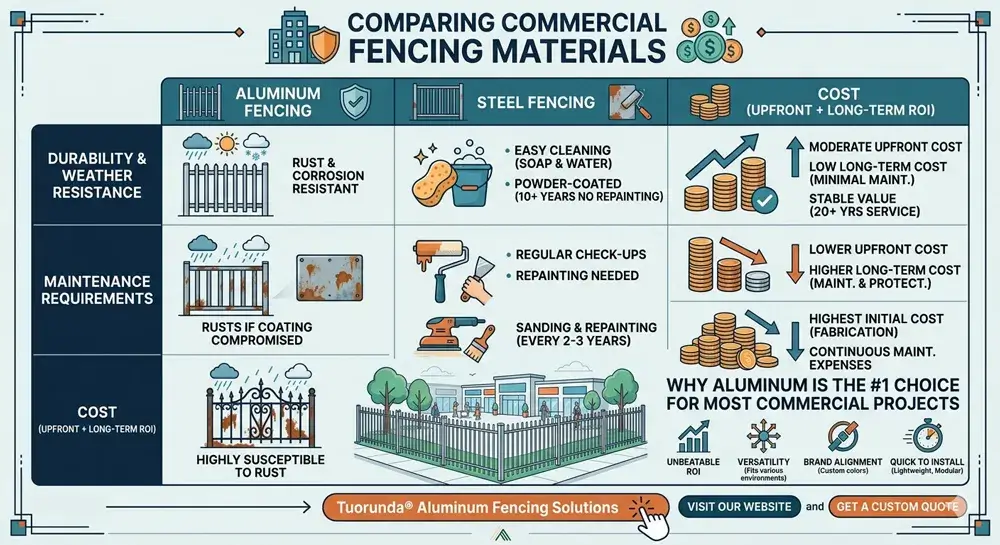
Durability and Weather Resistance
Aluminum: Aluminum fences are strong enough to withstand rust and corrosion. They don’t need heavy layers of paint and coatings to act as a protective barrier. The metal has a favorable weight to strength ratio, and protects well from extreme weather conditions including rainy, sunny, and cool temperatures. Aluminum fencing even do well in environments with salty air and water. Powder coatings also retain their color beautifully for many years.
Steel: Steel fencing is strong but is subject to rust if the protective coatings on the fencing are compromised. Coastal and moody weather can bring on rusting at an increased rate. Steel fences need to be repainted often to avoid rust.
Wrought Iron: Wrought iron is heavy and can be made into many different designs. However Wrought iron is also very susceptible to rust if the paint used to coat and protect the fencing is old and falling off. Old wrought iron in outdoor fences often suffer from rust. The fences must be repainted often to minimize rust.
Maintenance Requirements
Aluminum: Aluminum fencing is very low maintenance as it can simply be cleaned with soap and water. It is likely that powder-coated aluminum won’t need any kinds of repainting or refinishing for over ten years.
Steel: Steel fencing requires more regular maintenance than aluminum. Customers are advised to check how the coating is holding up each year. Rust that appears must be treated quickly. Refreshing paint and repairs of the surface are common during its useful life.
Wrought Iron: Wrought iron fencing is high-maintenance. Sanding and repainting of it must be done every two or three years. Rust touches must be addressed quickly to avoid the loss of the integrity of the fencing.
Cost (Upfront + Long-Term ROI)
Aluminum: Aluminum fencing usually has a moderate purchase cost. The long-term cost is low because maintenance is minimal. The service life can exceed twenty years. This creates stable value for commercial projects.
Steel: Steel fencing may cost less at the beginning. But maintenance and surface protection increase long-term expenses. Replacement may occur earlier if corrosion becomes serious.
Wrought Iron: Wrought iron fencing often has the highest initial cost because of custom fabrication. Maintenance expenses continue through the service life. The total cost can become very high for large commercial sites.
Security & Structural Strength
Aluminum: Commercial aluminum fencing can provide strong security when proper design is used. Thick aluminum profiles, reinforced posts, and anti-climb spacing improve safety. The structure remains stable for retail areas, office parks, and light industrial properties.
Steel: Steel provides very high raw strength. It works well for heavy industrial areas that require maximum protection. However, this level of strength is not necessary for many commercial properties.
Wrought Iron: Wrought iron fencing provides moderate security. Decorative elements may create thinner sections in the structure. Heavy weight may also place extra load on foundations.
Customizability & Aesthetic Appeal
Aluminum: Aluminum fencing offers flexible design choices. Powder coating can match many RAL colors. This helps businesses match brand colors and architectural style. Many designs are available, such as ornamental, modern, and anti-climb styles. The material is also easy to adjust for curved paths or irregular spaces.
Steel: Steel fencing usually has fewer finish options. The design often focuses on simple and functional structures. Custom adjustment for unusual spaces can be more difficult.
Wrought Iron: Wrought iron supports decorative patterns and traditional styles. However, production can take more time and cost more. The heavy decorative look may not suit modern commercial buildings.
Installation & Logistics
Aluminum: Aluminum fencing is light and easy to handle during installation. Workers can complete projects faster. Most systems use modular panels, which simplify assembly and future expansion.
Steel: Steel fencing is heavier and requires more labor during installation. Equipment may be needed for lifting and positioning. Installation time can increase project cost.
Wrought Iron: Wrought iron fencing often requires custom fabrication and detailed fitting on site. The heavy structure needs stronger foundations. Installation may take a long time, which can delay commercial project schedules.
Why Aluminum Fencing is the #1 Choice for Most Commercial Projects
Unbeatable ROI
Aluminum fencing offers strong value over time. The initial cost is balanced and reasonable for many commercial projects. Maintenance is very low. This reduces long-term expenses. Many aluminum fences can last more than twenty years. The total cost of ownership stays lower than many other materials.
Versatility
Aluminum fencing fits many commercial environments. It works well for retail plazas, office campuses, light industrial parks, and public buildings. It also performs well in coastal areas where moisture and salt air are common.
Brand Alignment
Aluminum fencing supports flexible design. Powder coating allows many color options. Businesses can match fence color with building style or brand identity. This helps improve the visual image of the commercial property.
Years of Reliability
Aluminium does not rust or corrode. It performs equally, rain or shine, heat or cold. When taken care of, many systems will last decades.
Quick to Install
Aluminium fencing panels are lightweight, making them easier to handle. Because they are easier to install, they reduce business disruptions and allow projects to be opened sooner.
Environmentally Friendly
Aluminium can be recycled in its entirety. Powder coating finishes, during their entire usable life, do not emit toxins. This aligns with the goals of sustainable construction and the responsible selection of materials in commercial construction.
Exceptions: When to Consider Steel or Wrought Iron
Steel
Steel fencing can be suitable for some heavy industrial projects. Examples include manufacturing plants and storage facilities that hold high-value equipment. These sites often require maximum structural strength and strict security control. In these situations, owners may accept higher maintenance cost and regular surface protection work.
Wrought Iron
Wrought iron fencing may be used for historic or landmark commercial buildings. Examples include heritage hotels, historic shopping streets, or cultural sites. These projects often focus on traditional appearance and decorative patterns. Owners usually prepare a maintenance budget to keep the surface paint and structure in good condition.
Key Note
For most modern commercial projects, aluminum fencing remains the more practical option. It provides strong durability, low maintenance, flexible design, and stable long-term value for many types of commercial properties.
Tuorunda® Aluminum Fencing Solutions for Commercial Projects
Our commercial-grade aluminum fencing product line
Tuorunda® provides several aluminum fencing solutions for different commercial needs. Ornamental aluminum fencing works well for retail plazas and office campuses that require strong curb appeal. Anti-climb aluminum fencing improves security for sites that need stronger protection. Industrial-grade aluminum fencing suits light industrial parks and warehouse areas. Custom aluminum fencing is also available. This option helps projects with special layouts, irregular spaces, or unique architectural styles.
Core product benefits tailored to commercial needs
Tuorunda® aluminum fencing uses high-quality powder-coated finishes. These surfaces resist fading and rust for more than fifteen years under normal outdoor conditions. Reinforced posts and different gauge options improve structural strength and meet commercial security standards. The modular system supports fast installation and future expansion. This design also makes repair or modification easier for large commercial properties. Global supply service and installation support are available for international projects.
Case study snippet
A retail plaza project replaced an old steel fencing system with Tuorunda® aluminum fencing. The new system reduced maintenance work by about ninety percent. The cleaner design also improved the appearance of the property. This helped the project attract more tenants and maintain stable occupancy.
Conclusion
Aluminum fencing performs well in many important areas. It offers strong durability for outdoor use. Maintenance needs stay very low over time. The long service life helps control project cost. The material also supports flexible design and faster installation. Because of these advantages, aluminum fencing fits many commercial projects better than steel or wrought iron.
Businesses often look for fencing that provides security, stable performance, and a clean appearance. Aluminum fencing meets these needs for many retail plazas, office campuses, and commercial sites. The balance of strength, value, and simple maintenance makes it a practical long-term choice.
Contact Tuorunda® to request a custom quote for your commercial aluminum fencing project.
Our team can review your site size, security needs, and design style. Then we suggest a suitable aluminum fencing solution. Visit our website to learn more about our commercial aluminum fencing products and project examples.
